
If you’ve been researching car body repair shops in Paisley or have been involved in an accident, you’ve probably come across the term BS 10125. Your insurer may have mentioned it, or you may have seen it on a bodyshop’s website. But what does it actually mean — and why should it matter to you as a vehicle owner?
This guide explains exactly what BS 10125 is, what it covers, and why choosing a certified bodyshop like Linwood Coachworks protects both your vehicle and your safety.
What is BS 10125?
BS 10125 is the British Standard for the repair of light vehicles. It sets out the requirements for vehicle body repair processes, materials, equipment, and the competency of repair technicians. It was developed by the British Standards Institution (BSI) and is recognised across the UK automotive repair industry as the benchmark for quality and safety in bodywork repairs.
The current version — BS 10125:2022 — covers everything from minor cosmetic repairs right through to major structural repairs following serious accidents.
What Does BS 10125 Cover?
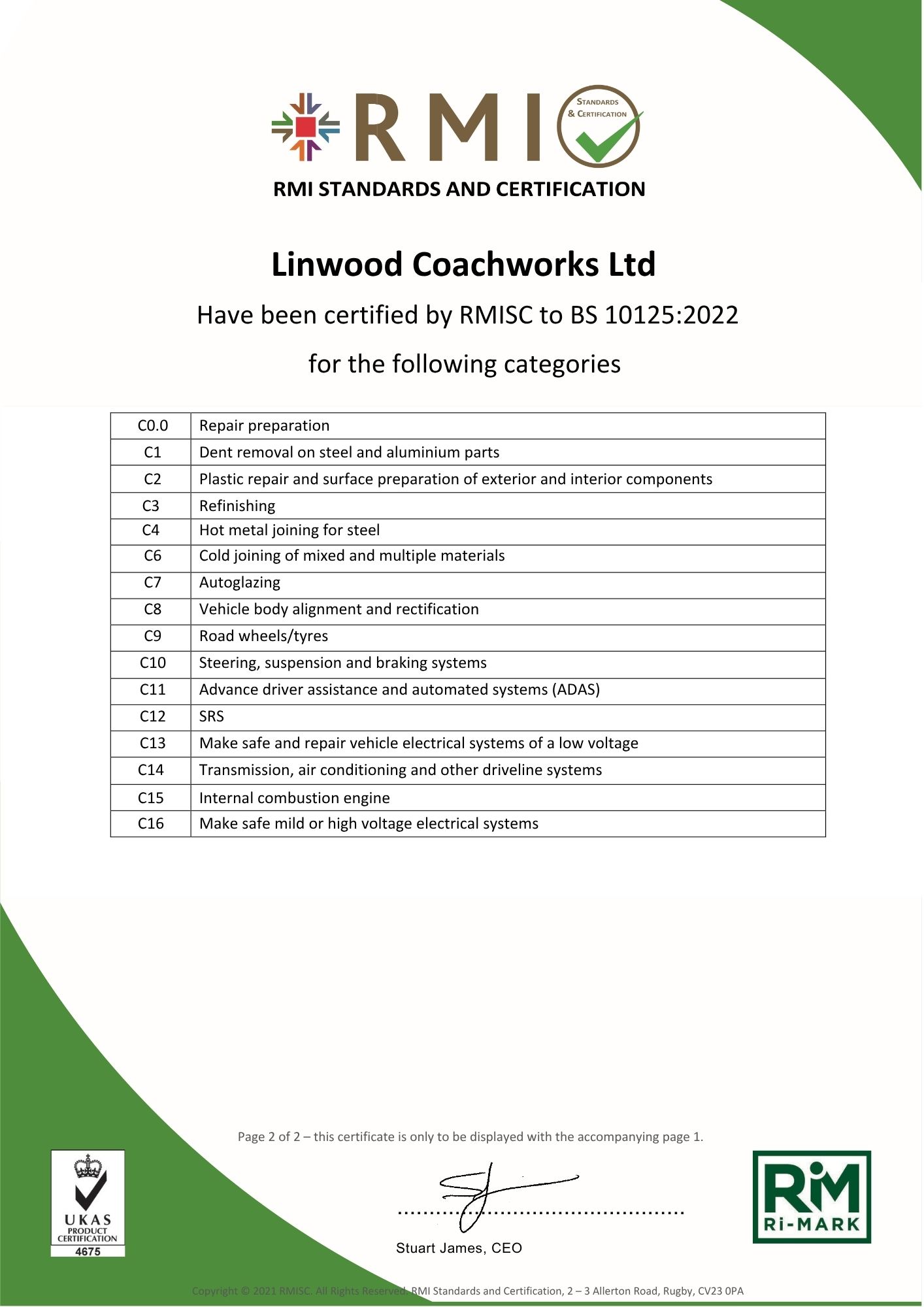
BS 10125 certification is awarded across specific repair categories. A bodyshop must demonstrate competency in each category it is certified for. Linwood Coachworks holds certification across all 16 categories:
- C0.0 — Repair preparation
- C1 — Dent removal on steel and aluminium parts
- C2 — Plastic repair and surface preparation
- C3 — Refinishing
- C4 — Hot metal joining for steel
- C6 — Cold joining of mixed and multiple materials
- C7 — Autoglazing
- C8 — Vehicle body alignment and rectification
- C9 — Road wheels and tyres
- C10 — Steering, suspension and braking systems
- C11 — Advanced driver assistance and automated systems (ADAS)
- C12 — SRS (airbag and seatbelt systems)
- C13 — Vehicle electrical systems (low voltage)
- C14 — Transmission, air conditioning and driveline systems
- C15 — Internal combustion engine
- C16 — Mild or high voltage electrical systems
Full certification across all 16 categories means we can handle any repair — from a minor dent to complex structural and electrical repairs on modern vehicles including hybrids and EVs.
Why Does BS 10125 Matter for Your Car Repair?
Modern vehicles are significantly more complex than they were even ten years ago. Advanced driver assistance systems (ADAS), airbags, crumple zones, high-strength steel panels, and hybrid or electric powertrains all need to be correctly repaired and recalibrated after an accident. A repair that looks cosmetically perfect but hasn’t been carried out to the correct standard can leave safety-critical systems compromised.
BS 10125 certification gives you assurance that:
- Repairs are carried out using correct materials and methods
- Technicians are trained and competent in each repair category
- Equipment meets the required standard for the repair type
- Safety-critical systems are correctly repaired and recalibrated
- Your vehicle is restored to its pre-accident condition — structurally, mechanically, and cosmetically
Does BS 10125 Affect My Insurance Claim?
Yes — and this is important. Many insurers require repairs to be carried out to BS 10125 standards as a condition of their policy. If your vehicle is repaired by a non-certified bodyshop, your insurer may refuse to cover the cost of the repair, or any future claims relating to that repair.
By choosing a BS 10125 certified bodyshop like Linwood Coachworks, you can be confident that your repair will be accepted by your insurer and that your vehicle’s warranty and resale value are protected.
How is BS 10125 Certification Awarded?
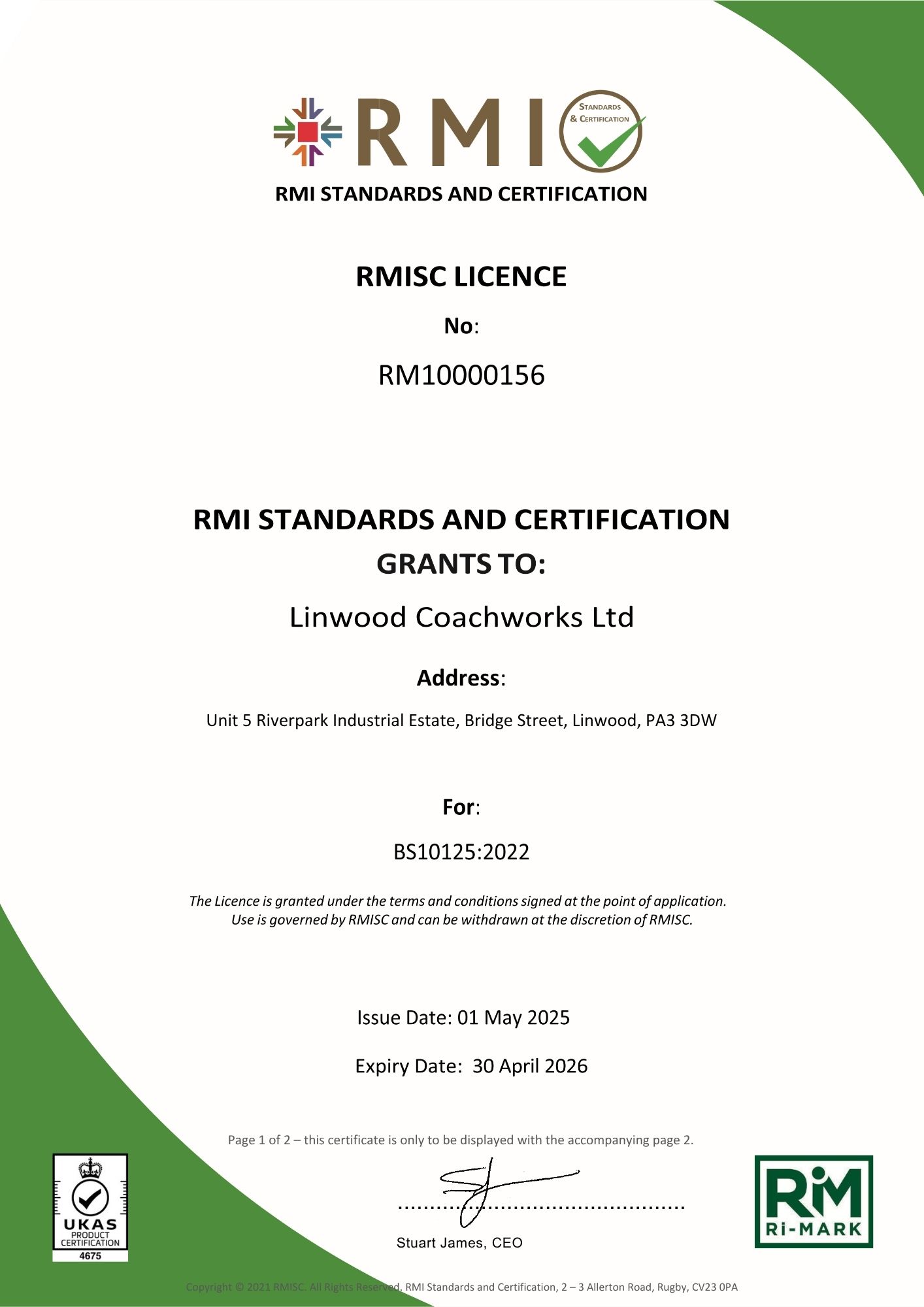
Certification is not self-declared — it requires an independent audit by an accredited certification body. At Linwood Coachworks, our BS 10125:2022 certification is issued by RMI Standards and Certification (RMISC), an accredited body under UKAS (United Kingdom Accreditation Service).
Our certification is reviewed and renewed annually, ensuring we continue to meet the required standard. Our current certification was issued in May 2025 and covers all 16 repair categories.
What’s the Difference Between BS 10125 and Manufacturer Approval?
BS 10125 is the national standard for vehicle body repair across all makes and models. Manufacturer approval (such as being an approved repairer for a specific brand) is separate and typically requires additional brand-specific training and equipment.
BS 10125 certification is the foundation — it proves a bodyshop meets the industry standard regardless of make or model. It’s the minimum you should look for in any bodyshop you use.
Linwood Coachworks — Fully Certified to BS 10125:2022
Linwood Coachworks has held BS 10125 certification continuously and is certified across all 16 repair categories. We’re audited annually by RMISC and our certification is backed by UKAS accreditation — giving you complete confidence in every repair we carry out.
Whether you need a minor dent removed or a major structural repair following a serious accident, every job at Linwood Coachworks is completed to BS 10125 standards and comes with a comprehensive guarantee.
Find out more about our accident repair service, our dent and scratch repair service, or read our insurance claim guide.
Call us on 07717 233864, email info@linwoodcoachworks.co.uk, or use our contact page to get a free estimate today.